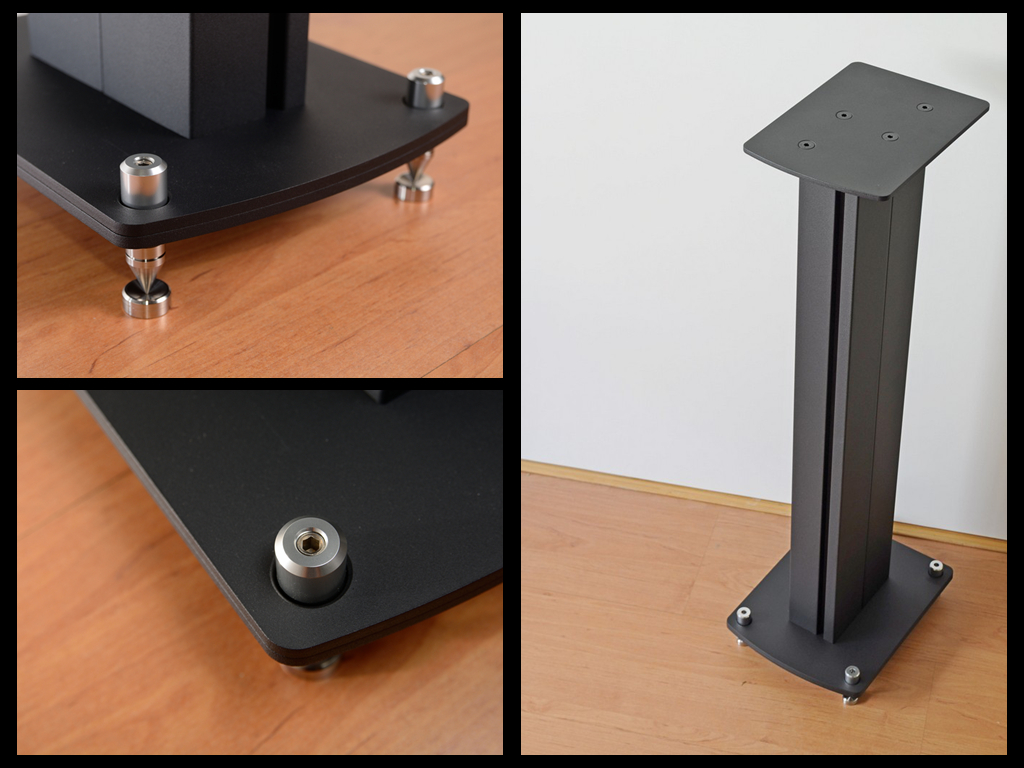
Speaker Isolation Feet and Speaker Stands: Achieving a 1+1 Greater Than 2 Listening Experience
Why Isolation Feet and Speaker Stands Should Be Considered Together
Many audiophiles tend to treat isolation feet and speaker stands as separate upgrades, assuming that choosing a good isolation foot or switching to a sturdier stand will independently improve sound quality. In reality, they are two interdependent parts of the same vibration control system. Taking Juese Audio's product line as an example, stands such as the ALT-D700 dual-pillar square aluminum alloy speaker stand or the ALT-RD600 curved dual-pillar aluminum alloy speaker stand cannot fully realize their structural advantages if used without properly matched isolation feet.
The Complementary Relationship Between Stand Rigidity and Foot Isolation
Speaker stands are typically designed to provide sufficient rigidity, giving the speaker driver a stable platform and minimizing energy loss from resonance within the stand itself. However, even a highly rigid stand will still transmit vibration through its contact points if placed directly on the floor, and that vibration can reflect back depending on the flooring material. This is where isolation feet play their role. Pairing an ALT series stand with Ø25mm or Ø36mm stainless steel isolation feet at its base creates a controlled buffer layer, ensuring the stand's rigidity isn't undermined by reflected floor energy, which is exactly where the 1+1 greater than 2 effect comes from.
Common Misconceptions When Pairing the Two
A common misconception is that heavier stands or harder isolation feet are always better. For example, a four-legged stand paired with isolation feet that have too small a contact surface can concentrate excessive load on single points, while overly soft isolation feet may absorb vibration effectively but undermine the stand's inherent rigidity. Juese Audio's ψ36mm stainless steel M8 self-locking isolation spike was designed to address exactly this trade-off, combining a self-locking thread structure with stable support, making it well suited for heavier stand setups.
How to Evaluate the Integration of Stand and Feet
When evaluating the pairing, three factors matter most. First, consistency in material rigidity, since pairing a stand and feet made from similarly dense materials like stainless steel or alloy tends to maintain more consistent vibration characteristics. Second, matching contact area with the stand's weight, lighter stands may pair well with Ø20mm isolation feet, while heavier systems benefit from Ø36mm feet or an enlarged support plate combined with M8 self-locking spikes. Third, supplementary damping components such as the AVP_85L_II or AVP_4M II alloy damping blocks can serve as an additional isolation layer between the stand and speaker cabinet, further reinforcing overall system consistency.
The Listening Improvements From Proper Pairing
When a speaker stand and isolation feet are properly matched, many listeners report tighter, more controlled bass, improved soundstage stability during extended listening, and a lower background noise floor that lets finer details come through more clearly. These combined effects are a concrete demonstration of the 1+1 greater than 2 principle.
Conclusion
Speaker isolation feet and speaker stands are not independent accessories but two parts of a single vibration control system. By pairing Juese Audio's ALT series stands with Ø series stainless steel isolation feet, M8 self-locking spikes, or AVP damping blocks, listeners can ensure the stand's structural strength and the feet's isolation performance reinforce one another for a listening improvement beyond what either upgrade could achieve alone.
Suggested Keywords: speaker isolation feet, speaker stands, ALT-D700, ALT-RD600, stainless steel isolation feet, M8 self-locking spike, AVP damping block, Juese Audio